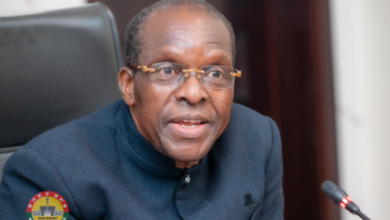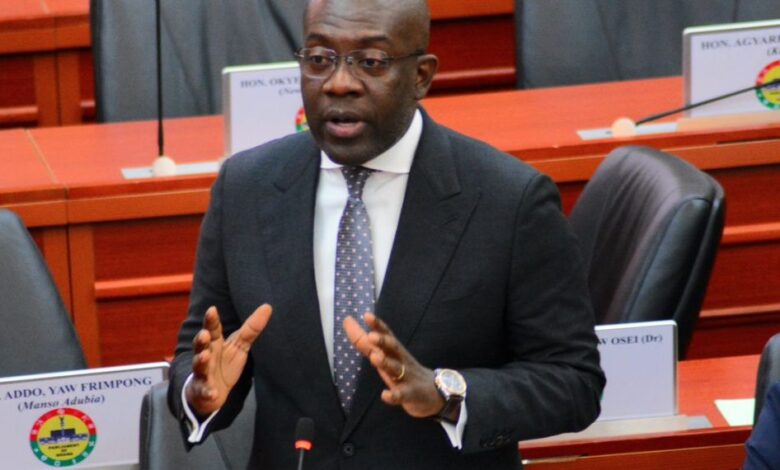
The Ranking Member on Parliament’s Economy and Development Committee, Kojo Oppong Nkrumah, has questioned the implementation of the NDC government’s flagship 24-Hour Economy programme, arguing that despite Parliament approving about GH¢650 billion in public spending over nearly two years, there is little evidence the policy has delivered its promised results.
Speaking on the floor of Parliament while seconding a motion to adopt the report of the Economy and Development Committee, Ranking Member on the committee and former Ofoase-Ayirebi MP, Kojo Oppong Nkrumah, said the government has failed to show any practical implementation of the programme nearly two years after taking office.
He recalled that the 24-Hour Economy was marketed as a major industrialisation and employment initiative based on the “1-3-3” model, one job, three people, three shifts expected to create thousands of new jobs through round-the-clock operations in both public and private sectors.
Mr Oppong Nkrumah noted that despite repeated calls by the Minority for the government to present major policy documents to Parliament, the 24-Hour Economy remains one of the few substantive policies formally submitted to the House.
He argued that after nearly two years, the government has not been able to identify even a single public institution operating under the promised “one job, three shifts” framework.
“For all the stories that were told and all the promises that accompanied the 24-Hour Economy, almost two years after assuming office, there is not one government agency implementing the one-three-three model,” he told Parliament.
The Minority MP said committee deliberations revealed that the government is now shifting focus to constructing 24-hour markets and designing incentive packages for private sector operators. He questioned whether building new markets would automatically result in continuous economic activity when many existing markets already struggle beyond designated market days.
He also criticised the government for admitting that the incentive framework needed to encourage private companies to adopt round-the-clock operations is still under development.
Mr Oppong Nkrumah argued that the 24-Hour Economy has effectively displaced the One District, One Factory (1D1F) initiative, which he said was already delivering measurable industrial outcomes. Citing the National Development Planning Commission’s 2024 Annual Progress Report, he said at least 150 1D1F projects were operational by the end of 2024.
He urged the government to reconsider its approach by reviving and improving the One District, One Factory programme instead of abandoning it for an unproven framework.
The Minority MP warned that the delay in implementing an effective industrialisation strategy carries serious consequences for employment, especially among the youth. Quoting the Ghana Statistical Service, he said youth unemployment has risen to approximately 32.4 per cent.
He maintained that the industrialisation agenda cannot afford prolonged delays and must move beyond campaign promises to deliver tangible results through factories, expanded production, and sustainable jobs for Ghana’s growing youth population.
Editor:
Obiri-Yeboah