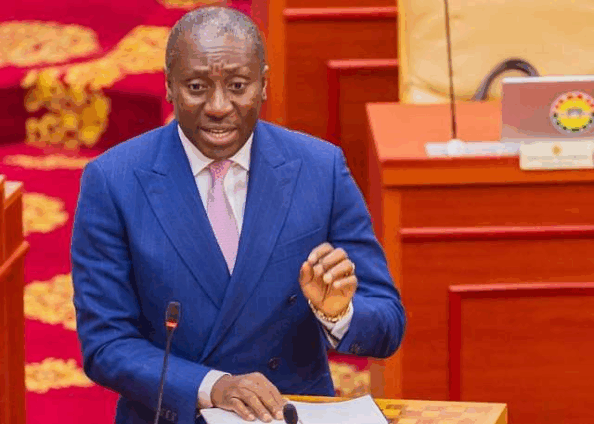
Minority Leader Alexander Afenyo-Markin has described former Vice President and NPP flagbearer Dr. Mahamudu Bawumia as the leader best placed to carry forward the ideals of the Danquah-Dombo-Busia tradition in Ghana’s modern technological and economic landscape.
Delivering a lecture at the Young Commons Forum organised by students of the Kwame Nkrumah University of Science and Technology (KNUST) and Kumasi Technical University on Saturday, June 20, Mr Afenyo-Markin argued that Bawumia has successfully adapted the tradition’s core principles of individual liberty, private enterprise, and equal opportunity to address contemporary national challenges.
“Every tradition that survives across generations must answer the same question each time leadership passes to a new hand: does this successor carry the inheritance forward, or only invoke its name?” he said.
“The case I wish to make is that Dr. Mahamudu Bawumia has done the harder thing… He is the next chapter of this tradition,” he declared.
Political Lineage
The Effutu MP traced Bawumia’s political roots to the early days of the Danquah-Dombo-Busia tradition, noting that his father, Alhaji Mumuni Bawumia, was a founding member and vice chairman of the Northern People’s Party alongside Chief S.D. Dombo.
He said Bawumia’s vision is centred on inclusivity, economic transformation, and technological advancement, with the goal of building a country that harnesses the talents of all citizens irrespective of ethnicity, religion, or political affiliation.
Key Pillars of Bawumia’s Vision
Mr Afenyo-Markin outlined what he described as the main pillars of Bawumia’s agenda, including macroeconomic stability, fiscal discipline, private sector-led growth, tax simplification, digital transformation, reduction in the cost of living, value addition to natural resources, and stronger accountability mechanisms.
He emphasised Bawumia’s focus on maintaining low inflation, stable exchange rates, and prudent government spending, while reducing the size of government and encouraging greater private sector participation in infrastructure development.
The Minority Leader also highlighted Bawumia’s strong emphasis on digitalisation, artificial intelligence, and data-driven governance to modernise public services, agriculture, healthcare, and education.
“Big Tent” Philosophy
Afenyo-Markin argued that Bawumia’s “big tent” approach mirrors the inclusive coalition-building that defined the formation of the United Party in the 1950s, bringing together diverse ethnic, regional, and religious groups under a shared vision.
He maintained that Bawumia’s leadership represents a modern expression of the Danquah-Dombo-Busia philosophy rather than a departure from it.
Defence of NPP’s Social Interventions
The Minority Leader mounted a strong defence of the NPP’s record on social interventions, crediting former President John Agyekum Kufuor with replacing the “cash and carry” healthcare system with the National Health Insurance Scheme (NHIS).
He also highlighted the introduction of the Capitation Grant, Free Compulsory Universal Basic Education, and the School Feeding Programme under Kufuor’s administration.
Turning to the Akufo-Addo era, Mr Afenyo-Markin described the Free Senior High School (Free SHS) policy as one of the most transformative social interventions in Ghana’s Fourth Republic, saying it aligned with the tradition’s emphasis on human capital development.
He further cited the expansion of Technical and Vocational Education and Training (TVET), the One-District-One-Factory (1D1F) initiative, Planting for Food and Jobs (PFJ), and the Agenda 111 hospital project as key achievements.
Contrast with NDC
Afenyo-Markin drew a sharp contrast with the National Democratic Congress (NDC), asserting that the party has no significant social intervention programme it has successfully introduced and implemented since coming to power.
“I contend therefore that the NDC has no single social intervention programme introduced by them and implemented successfully since they first had a chance to govern this country,” he told the students.
Editor:
Obiri-Yeboah