The Centre for Public Interest Law (CEPIL), under the Feminist Mineral Initiative (FMI) and with funding support from Oxafm in Ghana, has held a day-long Town Hall Dialogue to educate communities affected by the Ewoyaa Lithium Project on the principle of Free, Prior and Informed Consent (FPIC), a foundational right that determines how communities are consulted before mining projects touch their lands, livelihoods and futures.
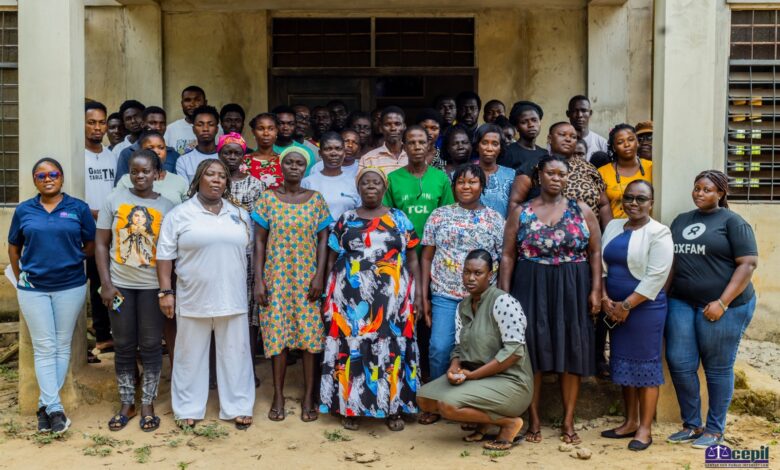
The dialogue, held at the Church of Pentecost in Krofu in the Mfantseman Municipality of the Central Region, brought together 52 participants, 26 men and 26 women, drawn from Ewoyaa and six surrounding communities: Krofu, Abonko, Anokye (Anokyi), Krampakrom, Afrangua, and Ansadze.
Participants included women, youth leaders, farmers and opinion leaders, all of whom are directly affected by the Ewoyaa Lithium Project, which is set to become Ghana’s first commercial lithium mine.
The session was designed primarily as an educational intervention to close a significant knowledge gap.
Although the project has moved from parliamentary ratification into implementation, bringing with it resettlement, compensation and the commencement of mining operations, many residents had limited prior exposure to the concept of FPIC and how it is meant to apply in practice.
Following the discovery of lithium deposits in 2023 and Parliament’s ratification in March 2026 of the mining lease agreement between the Government of Ghana and Barari DV Ghana Limited, a subsidiary of Atlantic Lithium, community members, civil society organisations and advocates have stressed that the right of affected communities to be meaningfully consulted must be respected and not bypassed in the interest of speed.
Using a plain-language, participatory approach, facilitators walked participants through the meaning of FPIC and its four core elements. Participants learned that consent must be free, given without coercion, intimidation, manipulation, or pressure; prior, sought and obtained before a project begins or before decisions affecting the community are finalised; informed, based on complete, honest and accurate information about a project’s risks, benefits and impacts, communicated in a language and format the community understands; and that consent itself means the community has the right to say yes, no, or yes with conditions and to have that decision genuinely respected rather than treated as a mere formality.
The facilitator used relatable, local examples to illustrate what each element looks like in practice within the context of the Ewoyaa Lithium Project, then guided participants through small-group discussions and an open-floor question-and-answer session. Participants engaged actively throughout, asking questions about how FPIC relates to compensation, resettlement and their rights to be consulted at each stage of the project.
Discussion underscored that FPIC protects communities’ rights over their lands, livelihoods, and natural resources, helps prevent decisions from being imposed on communities without their knowledge or genuine agreement and strengthens trust between communities, government and project developers by ensuring transparency from the outset. Participants also noted that FPIC provides communities a basis to negotiate fair terms, including on compensation, resettlement, and benefit-sharing.
The dialogue closed with a summary of key messages and agreement on practical next steps. CEPIL identified several areas for follow-up, including continued community-level FPIC education with simplified, translated materials residents can reference and share within their households; the establishment of a clear, accessible channel through which community members can request project information and raise consent-related concerns; and the documentation and communication, in plain language, of how past and future project decisions have incorporated, or will incorporate, community consent.
The intervention reinforces the Feminist Mineral Initiative’s objectives on transparency, accountability, and inclusive community participation in Ghana’s extractive sector.